dinsdag 20 september 2016

‘In 2050 moet al het afval worden hergebruikt’ - Nederland Circulair


‘In 2050 moet al het afval worden hergebruikt’, kopte de Volkskrant woensdag 14 september, naar aanleiding van de publicatie van de Rijksbrede strategie NL circulair in 2050
Daarmee bevestigt de krant een hardnekkige mythe rond circulaire economie die maar blijft rondzingen, namelijk dat circulaire economie eigenlijk hetzelfde is als recyclen, en dat er dus vooral een intensivering van gescheiden inzameling nodig is om kringlopen te sluiten en tot een duurzame productie en consumptie te komen. 

In de kringloop houden 

Maar dat is maar een klein deel van het verhaal. Wie zich een beetje heeft verdiept in de theorie en voorbeelden van de circulaire economie, kent de ‘de acht-op-z’n-kant’ van de Ellen MacArthur Foundation. Daarin zitten nog tal van andere en ook hoogwaardigere opties, elders in de waardeketen, gericht op het in de kringloop houden van materiaal.


Circulaire economie is een concept van een economie waarbij grondstoffen zo duurzaam mogelijk worden gewonnen, zo min mogelijk worden opgebruikt, zo lang mogelijk in de kringloop blijven, zo hoogwaardig mogelijk worden hergebruikt, in andere vormen opnieuw ingezet en tot slot wellicht toch nog afval worden, maar dan zo min mogelijk. En het gaat om een mondiaal concept dat een mondiale aanpak vereist vanwege de verwevenheid van de ketens en kringlopen.

Staatssecretaris: vervangen van primaire door secundaire grondstoffen

In het interview dat de Volkskrant met haar afnam doet ook staatssecretaris Dijksma zelf het concept circulaire economie tekort, door vooral op de vervanging van primaire door secundaire grondstoffen in te gaan, en op het wegnemen van belemmeringen voor het bedrijfsleven om gerecyclede grondstoffen te gebruiken. Als belangrijk issue noemt de krant het ‘weerbarstige probleem van de klassieke chipsverpakking’. 

Rijksbreed: anders produceren en consumeren

Het rijksbrede programma mikt daarnaast ook op hoogwaardiger benutting van grondstoffen zodat er (primaire) grondstoffen worden bespaard en op anders (‘nieuw’) produceren en consumeren. Dat zijn inderdaad belangrijke aspecten van een transitie naar een circulaire economie, zoals ook te zien in het schema dat de Ellen MacArthur Foundation hanteert.
Gezien de positie op de Europese en wereldmarkt kan dat niet in Nederland alleen. Een goed begin zou in Europa kunnen worden gemaakt. Economische instrumenten, nog steeds de heilige graal van veel milieu-economen omdat ze prikkels creëren voor duurzamer produceren en consumeren, zijn op een dood spoor gekomen. De praktijk is weerbarstiger gebleken dan gedacht – met uitzondering van een enkel voorbeeld, zoals de belasting op storten en verbranden van afvalstoffen (die als extra prikkel dient om recycling aan te moedigen). En volgens de staatssecretaris moeten we het daar niet van hebben: ‘Het is niet effectief om de verantwoordelijkheid af te schuiven op één partij in de keten, de ondernemers’. Daarbij ziet zij blijkbaar over het hoofd dat prijsprikkels (bijvoorbeeld heffingen op primaire grondstoffen) juist ook in de consumementenprijs zullen doorwerken en daarmee de consument tot andere aankoopkeuzes zullen aanmoedigen. Gelukkig staat dat wel in het plan, al zal het slechts mondjesmaat worden toegepast; economische instrumenten zullen in het algemeen pas echt werken als ze op grotere schaal (de hele Europese markt) worden toegepast. En dat is de afgelopen jaren nog ingewikkelder gebleken. 

Ecodesign

Een ander instrument om te zorgen dat de minst duurzame producten uit de markt worden gedrukt, is het stellen van minimumstandaarden aan producten. Dat zou heel goed kunnen middels ecodesign-eisen: een Europese richtlijn bepaalt dat producten een bepaalde mate van energie-efficiëntie moeten hebben om op de Europese markt te mogen komen. Deze regels zouden zo spoedig mogelijk ook aspecten als levensduur, hergebruik, repareerbaarheid, renovatie en recyclebaarheid van producten moeten gaan omvatten. De lidstaten zijn het daarover eens en hebben de Europese Commissie opgeroepen er vaart achter te zetten. Dit kan echt alleen Europees, vanwege de gemeenschappelijke markt voor veel producten. In het rijksbrede programma beschrijven Kamp (Economische zaken, dat ook energie, landbouw en voedsel omvat) en Dijksma (Milieu) dat er afspraken gaan komen met producenten, zodat nieuwe producten gerecyclede of biobased grondstoffen bevatten. Of, en zoja hoe dat kan gaan werken in een open economie als de Nederlandse is zeer de vraag.

Inspiratie voor transitie

Met de aansprekende vormgeving met veel praktische voorbeelden en ‘talking heads’ is het programma richtinggevend, inspirerend en mobiliserend van aard. Het noemt tal van grotere en kleinere acties die al lopen of nog zullen worden opgestart of al op gang zijn, vaak in samenwerking met het bedrijfsleven. Dat stemt hoopvol. Maar van de rijksoverheid verwachten we meer, en dan valt het toch tegen. Het plan bevat geen ‘roadmap’ van stappen die gezet zullen worden, er zullen geen extra middelen worden ingezet, er is geen zekerheid dat de afspraken met het bedrijfsleven tot resultaten leiden. De vereiste prioritering, versnelling en intensivering die nodig zijn om een transitie naar een circulaire economie te bewerkstelligen, blijven achterwege. Wel zijn er vijf prioriteiten benoemd, die elk hun eigen transitie-agenda zullen krijgen. Op zich is dat een goede zaak, want generieke afspraken zullen niet werken, elke sector heeft andere actoren en andere knelpunten die elk om een eigen aanpak vragen. 

Risico van versnippering vraagt om krachtige regie

Een risico bij zo’n aanpak is versnippering, waarbij alle afzonderlijke kleine plannen en acties elk hun eigen weg zullen gaan, en elk hun eigen dynamiek zullen kennen. De kunst zal daarom zijn hier de regie op te houden, te zorgen dat alle betrokken partijen het grotere doel in de gaten blijven houden en op koers blijven. Bovendien zullen SER, milieubeweging en Tweede Kamer de minister en staatsecretaris (en de andere betrokken bewindslieden zoals Ploumen en Koenders) bij de les moeten blijven houden, en voortgang op het gehele plan bewaken. Dan gaat het dus niet om de chipsverpakking. 


Terug naar mijn website: www.foxgloves.eu

woensdag 9 december 2015

Circular economy package out – is it what we were hoping for?


Last week, the European Commission published its long-awaited package on Circular Economy. Appraisals across the internet differ. For some the glass is quite empty, whereas others see it at least half full. [i]

The ambition level, especially in the quantified waste targets in the legislation accompanying the package, is lower than last year’s repealed proposal. The 2014 package called for a 70% recycling target for municipal waste for 2030, and a total ban on landfill for all recoverable and reusable waste. These have been watered down to a 65% recycling target for municipal waste (75% of packaging waste), and landfilling to be reduced to a maximum of 10% of all waste by 2030.

These are the most eye-catching elements of the package.The Action Plan includes further proposed or planned action, but the waste proposals are the only legislation.


So, let’s have a look at a couple of reactions:

EEB, by mouth of Stephane Arditi, its waste policy coordinator, is worried the package pretends to have high ambitions and lots of good intentions, but doesn’t really envisage a process that will transform it into concrete action. He is however, still optimistic and believes there are good positive signs and that the way forward will be to combine business and environment opportunities.[ii]

The group of Christian Democrats in the European Parliament (EPP) might be happy with the package, as it is as they wanted: regulation-light, market-driven.[iii] But Finnish EPP member Sirpa Pietikäinen told EurActiv that she was ‘struggling to find what is more ambitious in the new package’.

And the Alliance for Circular Economy Solutions (consisting of frontrunner business groups and several European environmental thinktanks) has calculated that this proposal makes for less jobs than the previous one.[iv]


Compared to previous plans

Compared to last year’s Circular Economy package, which was meant as Commissioner Potoćnik's cornerstone in the implementation of his ambitious Roadmap towards a Resource Efficient Europe (REE), this new package offers a mixed picture. Let's call into mind the vision of the REE Roadmap, published in 2011:  
By 2050 the EU's economy has grown in a way that respects resource constraints and planetary boundaries, thus contributing to global economic transformation. Our economy is competitive, inclusive and provides a high standard of living with much lower environmental impacts. All resources are sustainably managed, from raw materials to energy, water, air, land and soil. Climate change milestones have been reached, while biodiversity and the ecosystem services it underpins have been protected, valued and substantially restored - Roadmap towards a Resource Efficient Europe, 2011[v]

The REE Roadmap set milestones for 2020 for each type of resource or key issue, and tried to further operationalise these in intended or proposed actions for both Commission and Member States. As the Roadmap aimed at encompassing all relevant policy initiatives, it also included things that were actually already planned or underway (in the framework of Waste, air, water policy, REACH, etc). 

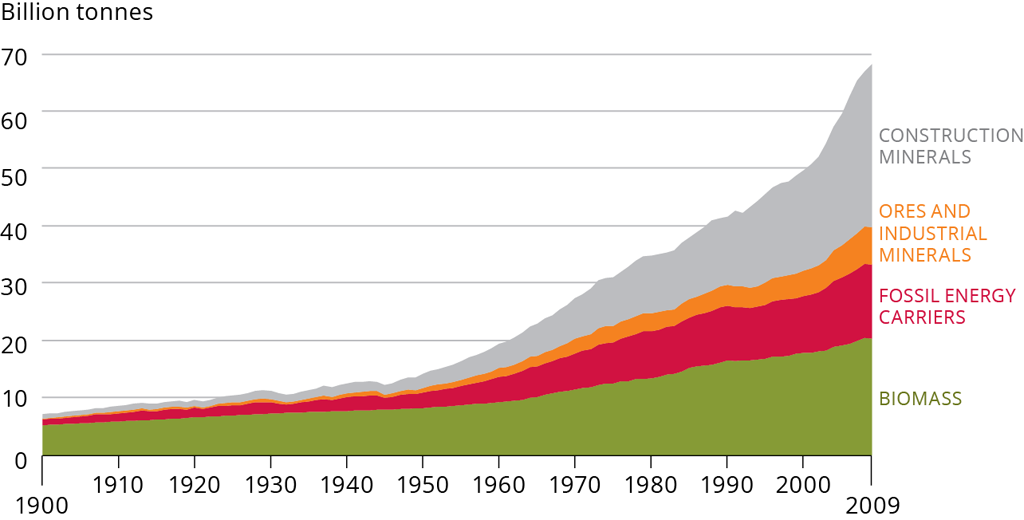
Global total material use by resource type (Source: EEA)


Sad to say, on many intended actions or ideas included in the REE Roadmap, progress has yet to be seen (e.g. on implementing environmental footprints, widening ecodesign to include material efficiency, tackling barriers to eco-innovation, phasing out of environmentally harmful subsidies), whereas progress on others has not yet been measured (e.g. redirecting research and cohesion funding). Member States, local and regional authorities have started to take action on some of the proposed initiatives, but as there is no binding target and no benchmark, nor a timeline to check progress, this is all very vague. Finally, assessing overall progress across the EU has not been possible, because the EU2020 Strategy reviews do not include resource efficiency. Only recently have we seen attempts by the Commission to assess this through the Annual Growth Survey. So progress on this admittedly very complex topic is fragmented, sometimes difficult, and it is not even very clear whether the REE Roadmap is the chief inspiration behind all the individual efforts.


This unsatisfactory situation is of course what EEB’s Arditi had in mind when he talked about good intentions. 


In an attempt to remedy this, the Circular Economy package was proposed in July 2014.  And after its repeal last year by the new Commission, and subsequent overhaul, this is where we are. The Communication actually retables several ideas already floated in the REE Roadmap, like those on Ecodesign, food waste, construction, sustainable consumption. However, on quite a few instances, the new package is more focussed and more action-oriented than both the previous one and the REE Roadmap, as it has a timetable and some Commission actions have been formulated in stronger terms than before.  


Elements in the package

The package is so extensive that it is not feasible to discuss all of the elements it proposes or identifies for further action.Here are a coupleof the eyecatching ones:

-        On the waste side, there is progress, with targets for recycling and landfilling, though less ambitious than was hoped for; though recycling targets could have been set higher. But in one of the accompanying documents, the Commission shows how it has weighed different options against each other, and that we need to bear in mind that the feasibility of these targets is not equal across Member States;  

-        Further encouragement of waste prevention; this is however left to the Member States and remains rather weak;

-        simplified and improved definitions and harmonised calculation methods for recycling rates throughout the EU (this will increase uniformity and clarity, while saving implementation costs);

-        BAT-reference documents for several industrial sectors will be adapted to include ‘guidance on circular economy’; this is promising, yet still rather vague;

-        Standards will be developed: for secondary raw materials (esp. plastics); for material-efficient recycling of WEEE and batteries; important and useful to increase the quality and efficiency of recycling across the EU;

-        Product requirements relevant to the circular economy (i.e. on repairability, recyclability, etc) will be included in the Ecodesign Directive; however, we will have to wait for the Ecodesign working plan for 2015-2017 to see how this will play out;

-        an independent testing programme under Horizon 2020 to help the identification of issues related to possible planned obsolescence (effectiveness will hugely depend on how this is undertaken, but it is an interesting new strand of research);

-        action on Green Public Procurement (GPP), by emphasising circular economy aspects in new or revised criteria, and leading by example in its own procurement and in EU funding (this is new, under the previous Commission this was not actively undertaken or even considered).

-        For further implementation of the many strands of the action plan, the Commission promises to create platforms, develop guidance pilots and targeted outreach. These could be helpful as accompanying measures.

What is still lacking, is demand-side policy, market instruments, setting the prices right, etc. However, as we all know, the Commission’s hands are tied, as these instruments require unanimity (which is not forthcoming). So the Commission cannot do much else than encourage or promote the use of these instruments.


Potential boost from society

So will this package fare better than the previous plans? What potentially will give this a boost now, as was not the case in 2011, is the fact that frontrunner business organisations are now pushing this agenda [vi] and there are many ‘circular’ initiatives and business models that have meanwhile sprung up.

There is larger public interested in more sustainable consumption: organic food sales have gone up, more and more restaurants are putting organic on the menu, there is an interest on declaring a war on waste,[vii] vegetarianism is becoming more accepted and available in shops and restaurants, as is more sustainable or ‘circular’ clothing[viii], there is increased demand for sharing and leasing instead of buying tools, cars, etc.


Don’t we need legislation, because all the rest is just ‘good intentions’?

There is indeed a need for legislation, but also of implementation of legislation that is already there, which requires sronger involvement of all levels of government, as well as business and society. These can be further increased by applying carrot & stick approaches, by co-financing investment in R&D. The Communication includes many of these elements. This package potentially has the tools. 


We count on Timmermans 

And now it is up to the whole Commission, not just Vella, to drive implementation. In industrial symbiosis, ecodesign, empowering the consumer, and boosting demand for material-efficient, circular products and services.
Greening the Economy cannot just be the responsibility of Commissioner Vella. We count on Commission Vice-president Timmermans to make his professed ‘firm belief’ in the circular economy heard across DGs, and his stronger ambition has to be echoed throughout the whole institution. Only then will we see  proposed actions on sustainable production and consumption, that for a long time seem to have been stalled by DG GROW, make certain progress.


What’s next

Next, it will be up to Parliament and Council to support or even strengthen the proposed actions and targets. Business organisations should put pressure on DGGROW and Economic Affairs ministers to support the Action Plan.

Experts negotiating on ecodesign and waste will have to demand ambitious working plans and targets (or at least not water down what the Commission puts on the table). Increasing cooperation between local governments, societal groups, and circular businesses, and redirecting funds for green innovation and investments, is a good idea for all those controlling purse strings. And of course, business can take its own responsibility for its side of the action plan.


So, I take the action plan and its timetable as a starting point for concerted action. See you in the Circular Economy!


Ilia Neudecker - Foxgloves Consultancy – Towards a sustainable Europe www.foxgloves.eu


[vi] In the UK, theAldersgate Group: http://www.aldersgategroup.org.uk/
In the Netherlands, de Groene Zaak: http://degroenezaak.com/about-us/
In Germany, Unternehmensgrün: http://www.unternehmensgruen.org/en/


[vii] UK chef Hugh Fearnley Whittingstall, and his War on Waste: https://wastenotuk.com/


[viii] Amsterdam-based ngo-cum-business network, Strawberry Earth, is particularly encouraging, as it aims at trendy young people: http://www.strawberryearth.com/